Showing posts with label Aphids. Show all posts

Wednesday, April 25, 2012

Critters Galore II

Springtime days have brought on lots of critter activity in our backyard paradise.

Baby Screech Owl 2010
Mommy Screech Owl 2012


The Screech Owl came back for a brief visit. She was a show stopping, speckled, calico color. The reason she has her wings out like that is to cool herself off. She wasn't worried about us. This year however it doesn't look as though we'll have any babies to coo over. We did have this privilege a few years back though.


"I'll be out in a few hours or thereabouts."
A multitude of different birds have taken to cheeping, cawing, peeping and singing in the trees, along with taking turns in the bird bath. They actually wait in line for a cool afternoon dip! I have to fill the bath up twice since they splash all the water over the sides. And of course the toad loves to wallow in there too. Biggest toad I've ever seen he is.


Female Carpenter Bee on Dianthus


Meanwhile the large, black carpenter bees have returned to the garden and are on patrol around the Sky Vine. I saw maybe one bee circling the vine about a week ago, and now there are many, and they all think the Sky Vine is their personal territory. I have even been dive bombed when I go out into the garden, but it's all for show - they are not going to sting me. Some even hide in the foliage and come flying out to intercept an interloper encroaching on their space. We have a few dead pine trees in the yard and they probably nest in there.


Too Bee or Not To Bee?
This is a picture of a rather scary looking 'bee.' Or is it??? I was amazed it let me get up close to it. But guess what it's not a bee or even a wasp! I cruised around online for identification, and it appears to be a Syrphid Fly. It mimics a bee so as not to get eaten. How to tell?
 1) has 2 wings not 4 wings
 2) stubby antennae 
 3) Big, BIG eyes! 


Now you know. 
Syrphid Flies favorite meal? Aphids.
Click below link for great website!
How To Identify Beneficial Insects in Your Yard


Left pic is Milkweed bug. Just what I need .... another insect chomping on the Milkweed, dramatic female sigh...


Monarch Caterpillars
These are the only little gals/guys I want to see on the Milkweed! They were both attempting to eat the teeniest morsel left on the stem, and, at one point started nipping at each other. It was interesting to see that they flattened their antenna much in the same way a dog puts its ears back when being hostile.
So cute!


Eventually we have this to look forward to in our butterfly garden.


Monarch Chrysalis
Just hatched and Drying Wings
Oh, and the aphids. Don't we just love the return of these nuisance insects. In my garden, they start on the peppers and then swiftly move on to the Milkweed.
Aphids on Milkweed
Aphids
But hold the soapy spray, help is on its way........


Bashful Ladybird
Welcome back the hungry, hungry ladybird. What took you so long?


But wait........ we need to make a mention of a super predator in my backyard paradise. I think it might be a male Blue Dasher. (Corrections are always welcomed and encouraged).

Male Blue Dasher
Juvenile Black Racer.
Want to know more about Dragonflies?
Click Here 


.....and while on the subject of predators. Here is a reminder why closed in shoes are necessary in the sub-tropical garden. 
A Black Racer. I moved a few pots around and it was curled up under there. 
Note to self: Put pot back quickly and back away.


That's my springtime tour of the garden and its various inhabitants.


Thanks for coming along with me!


Wednesday, March 16, 2011

The Return of The Bees, Aphids and Ladybugs

Now the weather is consistently warmer during the day, we have lots of really good stuff going on in our Backyard Paradise. 

Salmon Porterweed
The salmon/coral, porterweed finally bloomed after a torrential rainfall. 
I discovered online, that this color variety is Stachytarpheta mutabilis; a native of South America. The native blue/purple porterweed is called Stachytarpheta jamaicensis. We have both varieties in our yard. The mutabilis variety can get up to 8 feet high. Porterweeds attract bees, butterflies and hummingbirds. In addition to being very attractive, porterweed is drought tolerant, and blooms all year. It doesn't seem to like cool weather below 50 degrees F and just retires from blooming until it warms up.
 
While I was composting,  I heard an warning buzz close to my head. There, busily investigating the hibiscus, was a gigantic bumble bee. I am so glad to welcome back the big bees  along with the honey bees, wild halictid bee, which are bright, neon-green, and mason bees. The proliferate sightings of bees and butterflies is testimony that not using pesticides works. As I have a wooded lot, sooner or later I will also see the black carpenter bees, with whom the bumble bees have an ongoing turf war. On many occasions I have seen a bumble bee chase off a carpenter bee, and the carpenter bee will hide in the porterweed. The bumble bee will "patrol" the edges of the porterweed until the black carpenter makes a break for it, and then the bumble bee leaps into action and tries to chase her off again. I say "her" because according to the information found the link below, the black faced carpenter bee is the female, looking for food and a nesting site. http://en.wikipedia.org/wiki/Eastern_carpenter_bee
Ladybug going to Work
Note Coral Colored Abdomen
The warmer days have encouraged aphid activity into my garden, and onto my mammoth jalapeno and mini sweet peppers. Nasturtiums are reported to repel aphids - see my previous blog "Cup of Nas'tea' Anyone?" To protect my little ecosystem, I am always looking for ways of making, non-toxic, "bug-off" water-based solutions. So, I came up with the following; a big handful of Nasturtium leaves and flowers, a 1/4 cup white vinegar and an empty quart container. I boiled the Nasturtium plant material in tap water, and, with lid tightly on, allowed it to cool completely. Then I added this "soup" to a empty jug with the white vinegar and filled it up with tap water. For 3 days I dabbed this solution on the underside of the pepper leaves and sloshed it over the flower buds. I did see a significant reduction but I don't know if it would have eradicated them. But I can tell you this, over the 3 days I sloshed this mixture around on the plants, they "greened" up and grew maybe 3 inches apiece. That's significant growth. On the fourth day we came back from the beach to find that nature has stepped in. The ladybugs and their larva had discovered my horde of aphids...yummy! 
Folks, I am reading a great book at the moment: "The Organic Gardener's Handbook of Natural Pest and Disease Control "- Barbara W. Ellis and Deborah L. Martin. According to the authors' the black ladybug/bird, with coral head and abdomen - as shown in pictures - is a mealybug destroyer. I don't have mealybugs (yet), maybe they were just having lunch on the aphids on their way to a dinner date with mealybugs.
Lizard Defending Territory
While I was taking the ladybug close ups a lizard decided to engage in a territorial, stare down contest with me, complete with bobbing head (him, not me). You can see how close he/she was to me, a mere 2 feet away: very unusual behavior. 

Do you have an experience to share regarding a stand-off with a normally shy critter?


Saturday, March 12, 2011

Cup Of Nas'tea' anyone?

Nasturtiums
Oh the joy of a pot o’ Nasties! 
The fragrance, the color, the country charm of these enduring, grow-anywhere, and drought tolerant plants should endear themselves to any gardener! Their spicy-pepper, yet sweet aroma has ensnared me, hook-line and stinker sinker! I just love little bouquets of them popped into a small vase on my kitchen counter. I might be forgiven to be found inhaling their uniqueness with a rather foolish smile upon my face.
Here in sandy, South Florida, I just sow the seeds all over the place and they have popped up without any soil improvement. Having said that, they seem to generate more flowers with soil amendment, in potting soil that drains well, and watered occasionally with a weak Miracle Grow solution, but only when soil is dry.

The humble Nasturtium is considered by many to be an herb. Both the leaves and the flowers of Nasturtiums are reported to be edible, with a peppery taste that lends itself to addition in a mixed salad or vegetable dish. I have read of some accounts where folks stuff the flowers with cream cheese. Here is a link to a web site for some Nasturtium recipes. I think I will give the vinegar recipe a whirl.
Nasturtiums’ repel aphids. Vegetable gardeners can tuck them away with your peppers, tomats, cucumbers, and just about anywhere you can squeeze them in. Since the aroma of the leaves and flowers is both long lasting and easily absorbed by a water or vinegar solution, I might just put my mad scientist hat on and see whether I can make a solution from the plant material to rid my Sweet Mini Pepper plant of the aphids I discovered this morning - more on this in a future blog.
Varieties of Nasturtiums I have include: Fordhook (Capuchina), distributed by the Burpee seed company. Fordhook produces fragrant, single flowers in many colors, is a climbing variety of up to 6 feet in hight, full sun/partial shade, and is very attractive to hummingbirds. 
A "Jewel" Indeed
Then there is Jewel (distributed by Ferry-Morse). Blooms are semi-doubled and slightly ruffled with stand out colors of yellow, orange and scarlet, seen here as the top yellow flower. Jewel is no wallflower either! The flower head is held well above the leaves. According to Ferry-Morse, Jewel makes a good edging and planter-box flower. I grow mine in a large wicker basket in the garden and they come back year after year. 
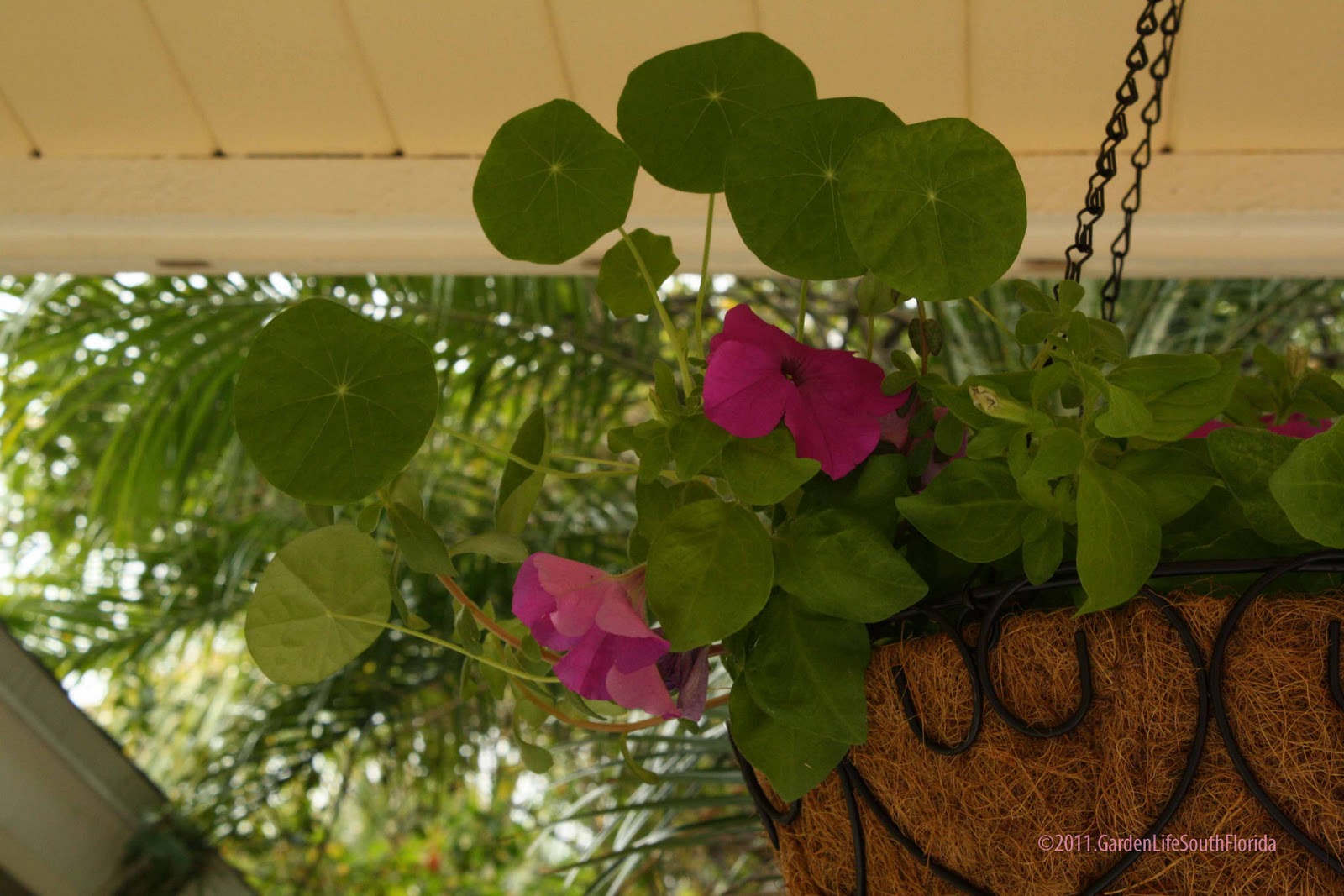
"Scarlet Gleam" Leaves Above Petunias
Also by FM is Scarlet Gleam, with big-orange-red flowers and bushy appearance. This Nastie is recommended for hanging baskets, and also for borders. Here is a picture of my hanging basket that I eagerly await some flowers of Scarlet Gleam to appear in.
Nasturtiums germinate from seed faster by nicking the seed. My method is just putting them in a jug of warm water overnight and then planting them the next day. They reseed profusely and I collect as many still-green, seed pods as I can, and dry them on paper towels.
Here in Florida they do really well during the cooler months of November through to our baking hot, late June, when they stop producing flowers and wither away. They won’t tolerate the humid 90 + degree heat and the prolific, amount of rain, which makes their roots soggy.
Thompson & Morgan, Inc. (www.thompsonmorgan.com), stocks a double Nasturtium with a hardiness zone 10-11 - “Double Delight Apricot.” I think I might have to find some room for it!
For more information on Nasturtiums, I found this video online.


Related Posts Plugin for WordPress, Blogger...